



Rakab is one of the leading companies in the field of manufacturing and insulating ducts (air ducts) using high-quality sheet metal, and it relies on a team of highly competent engineers.
The fabrication and insulation of ducts require a specialized company with experience in the field of air conditioning that adheres to international standards in the production and fabrication of air ducts. Ducts are metal panels through which air passes so that it can be distributed evenly throughout a space, while also protecting the air from contamination.
The materials used in the manufacture and insulation of ducts are high-quality, corrosion-resistant, and oxidation-resistant, such as galvanized sheet metal, stainless steel, or aluminum.
These vents come in a variety of shapes, including square, rectangular, oval, and circular, and all serve the same purpose: to transport and distribute air throughout the space, regardless of their shape or size.
What are the stages of duct fabrication and insulation?
The manufacturing process for air conditioning ducts involves several stages, which we will describe in detail below:
1. Design Development
The first step in manufacturing ductwork is for a specialized engineer from the company to design the blueprints after inspecting the location where the central air conditioning system is to be installed. The planning process for manufacturing the air ducts then begins, and in this process, care is taken to use the type of sheet metal appropriate for the location.
2. Supply of sheet metal
The engineer arranges for the required sheet metal to be supplied by the supplier and informs the supplier of the appropriate thickness, external dimensions, and length, keeping in mind that if the width and length of the ducts are increased, the thickness of the sheet metal must also be increased.
3. Sheet Metal Reinforcement Work
The engineer performs certain procedures to increase the strength of the sheet metal so that it is not prone to bending or warping during installation. This is done by creating indentations on its outer surface using specialized equipment called a corrugator, These indentations take the form of intersecting lines resembling the letter “X” or straight lines.
4. Cutting Sheet Metal
The sheet metal is cut and divided to fit the space, in accordance with the dimensions specified in the central air conditioning plans. The next step is the fabrication of the air ducts, for which one of several shapes—such as elbows, boxes, and others—is selected.
5. Sheet Metal Bending
Some panels are used to bend sheet metal so that it fits the angles of the space, and there is a specialized device for this purpose to ensure that the ducts are shaped to fit the layout of their installation site.
6. Sealing the sheet metal
Finally, the engineer seals the sheet metal for the ducts so that they are ready for installation in their designated locations. Inside the air ducts, vanes are installed at the elbows to help the cool air circulate properly and ensure even distribution throughout the space. If you’d like to learn more, you can check out theManufacture and Installation of Ducts and More An Air Conditioning Company in the Kingdom.
The Most Common Types of Air Conditioning Units
Ducts are available in many different shapes, from which the engineer can choose the one that best suits the layout of the space. The most important of these shapes are as follows:
- Circular Shape: It is best to use this type if the ceiling is made of gypsum, and the beams are manufactured in sizes appropriate for the diameter.
- Oval shape: This type is similar to the circular shape, but there are slight differences in how it is manufactured.
- Rectangular shape or square shape: This is a type of ducting suitable for spaces without a ceiling, where the air ducts are installed in suspended ceilings.
Types of Air Conditioner Coils
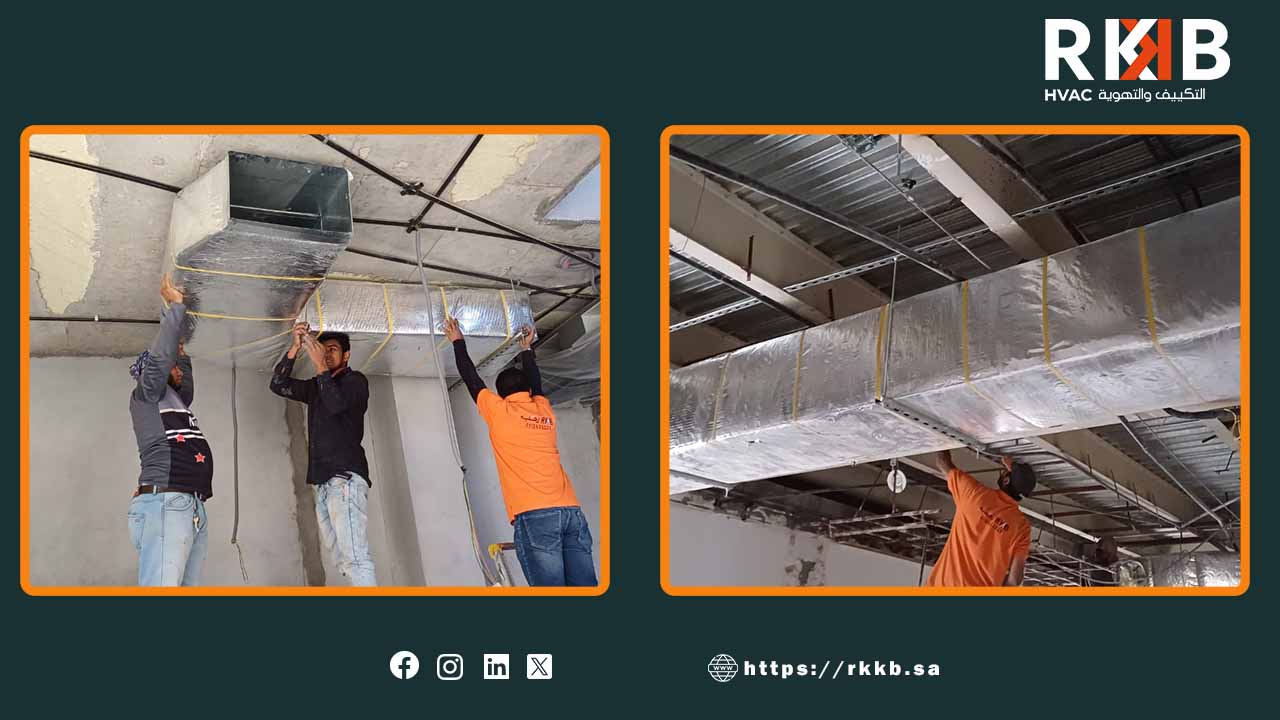
There are several types of air conditioning systems to choose from, and the selection is made by a specialized engineer after the space has been designed. The most important of these are as follows:
1. Dr. Al-Qamashi
A fabric duct, as its name implies, is made of fabric, and its mechanism of operation relies on the distribution of air through holes located inside the ducts, where inside Airflow A special type of fabric with small holes through which air flows to the elbows.
2. Flexible Duct
Flexible air ducts can be made of metal or plastic; some are insulated with fiberglass, while others are not. The most important feature of these ducts is that they can be easily bent at various angles, and they are usually made of highly flexible materials such as polyurethane.
3. Helical drills
Spiral ducts are the ideal choice for large spaces; they are often manufactured on-site using specialized machinery that shapes flat metal strips into the desired form.
4. Pre-insulated pipes
Pre-insulated air ducts are characterized by a foam coating and an additional layer of textured aluminum. You can learn more by visiting Central Air Conditioning Units: Types and Key Benefits.
Design Guidelines for Decks from Rukab
There are a variety of standards that any manufacturer specializing in ductwork must take into account when manufacturing air ducts, the most important of which are as follows:
- Pipes should be as short as possible to minimize the number of elbows, fittings, and various branches used, as this affects the overall cost.
- The best types of tires recommended are round or oval ones rather than rectangular ones, because they experience less air pressure drop.
- If you design rectangular ducts, the ratio of the longer dimension to the shorter dimension should be 4:1.
- When manufacturing flexible sewer pipes, their length should be minimized as much as possible.
- The air conditioner must be installed as close as possible to the area to be cooled, and it must not be noisy when in operation.
How to Install Air Conditioning Ducts
The installation process for air conditioning ducts involves several steps, which we will explain in order below:
- Before beginning the fabrication and insulation of the ducts, there must be a roof in place; if there is none, the engineer must construct one by determining the amount of energy required, taking into account the size of the space, the climatic conditions, and the direction of the sun.
- The engineer draws up the plans for installing the ducts and then determines the materials needed and their dimensions for constructing the air ducts.
- The ceiling is prepared by installing a framework to support the ducts through which the airflow passes, after which the outdoor unit and indoor unit of the air conditioner are installed and connected to each other.
- The ducts are installed throughout the space and in the ceiling, a process that may take up to about a week.
Key Benefits of Air Compressors
- The installation of air ducts has many benefits and advantages that vary from one type to another, and we will explain some of the most important ones below:
- Pre-insulated ductwork is lightweight compared to other metal ducts, which makes installation quick and easy and allows for greater flexibility in shaping.
- Insulated air ducts are considered more hygienic than metal ducts because they do not provide a favorable environment for the growth and spread of mold, and air leaks rarely occur in them.
- Fabric air ducts are among the best types of ducts, as they distribute air to the outside more efficiently through their openings.
- Fabric air ducts allow you to control airflow through the filter installed in them.
- The installation process for ducts is simple: the suspension cable is first installed, and then the duct is mounted on it; the cost is also relatively low.
- Duct cleaning can be done easily, both inside and outside, at a low cost.
- Air ducts can be easily moved from one place to another, and they come in a variety of shapes and colors so you can choose the ones that best match your decor.
Conclusion
The manufacturing and insulation of ducts must be carried out by a specialized company, and this process involves several stages, the first of which is the preparation of designs and blueprints for the air ducts in the facility.
Next, the sheet metal is procured in the appropriate gauge, reinforced, cut to size according to the area, and finally secured so that it is ready for installation.
Ducts come in many different shapes, such as circular, oval, square, and rectangular.
There are also various types of HVAC ducts, such as fabric ducts, flexible ducts, spiral ducts, and pre-insulated ducts. In all cases, they must be manufactured by a specialist to ensure compliance with the most important guidelines for air duct design, so that they achieve the required efficiency.


